Bloomington, Illinois

“Pretty soon all that is going to be left of Route 66 will be your photographs,” my husband said as we drove through Miami, Oklahoma, where old Route 66 has been franchised into oblivion. Gone are the Cherokee Motel and wedding parlor. The Coleman Theatre still stands proudly in the center of downtown. We followed the signs to Old 66 on the way out of town and got lost on a road that looked like somebody’s driveway.

Visit alongroute66.com and choose your three images for $94

plus shipping and handling.

Two days left in the sale: Buy 2 8 x 10 prints for $94, get one free.

Go to  alongroute66.com.

St. Louis, Missouri

Maybe you cruised Route 66 last summer or the summer before or the one before that. Go to alongroute66.com.

Gascozarck, Missouri

Maybe you know someone who would love a classic black and white photograph of a classic Route 66 landmark. Go to alongroute66.com.

Vinita, Oklahoma

Go to Along Route 66 and cruise the old road from your desk.

Amarillo, Texas

I am offering 8 x 10 black and white prints for $47, which I can have in your mailbox within a week of ordering. Go to alongroute66.com.

Tucumcari, New Mexico

In addition I have selected color prints, also for $47, also delivered within a week of ordering, at quintascott.com. Go to alongroute66.com.

Winslow, Arizona

Go on, Go to alongroute66.com, Arizona, and give someone a special Route 66 Christmas from alongroute66.com.

Amboy, California

Remember: Buy 2 8 x 10 Prints @$47 each, Get one Free.

And don’t forget the bookstore at alongroute66.com.

106 SantaMonicaPier

Santa Monica Pier from alongroute66.com

When Susan Croce Kelly and I were researching our book, Route 66: The Highway and its People, we decided that the Santa Monica Pier was the spiritual, if not actual end of Route 66. After all the highway that started on the edge of Lake Michigan should end at the Pacific Ocean.

SantaMonicaPier

Merry-Go-Round, Santa Monica Pier

But, we did have ground to stand on. In 1952 the folks of the U.S. Highway 66 Association, a group of business owners the length of 66 who loved road trips as much a the current 66ers, motored down the highway in a caravan to the very edge of the Pacific Ocean, named the highway the Will Rogers Highway, and dedicated a plaque to the highway and Rogers.

Route66Caravan

U.S. Highway 66 Caravan from Route 66: The Highway and its People

Now the City of Santa Monica has made it semi-official and made the pier the end of Route 66.

For a list of  good books on Route 66, including my Along Route 66, a really good read-aloud guide book, and Route 66: the Highway and its People, a really good history of the road, go to my bookstore.

The Chicago Portage

The Chicago Portage National Historic Site

“We could go with ease to Florida in a bark and by very easy navigation. it would be necessary to make a canl, but cutting through a half league of prairie, to pass from the foot of Lake Michigan to the Des Plaines River.” –Louis Joliet, 1673

The only impediment to navigation between Lake Michigan and the Mississippi River was the Chicago Portage, a low continental divide just west of Chicago.

Native Americans recognized that the Chicago Portage was the shortest route between the St. Lawrence River, which drains to the Atlantic, and the Mississippi, which drains to the Gulf of Mexico.

Pere Jacques Marquette and Louis Joliet returned to Lake Michigan after their discovery of the Mississippi, a trip which took them as far south as the Arkansas before they turned back. They began their trip in Green Bay, which took them to the Fox River, across a divide to the Wisconsin, and down the Wisconsin to the Mississippi.

They returned to Lake Michigan via the Illinois River, the Des Plaines River, and the Chicago Portage.

The Des Plaines is the northern branch of the Illinois and flowes from southern Wisconsin south parallel to and five miles west of the Illinois shore of Lake Michigan. The river turns south west two or three miles east of a swamp known as Mud Lake, which fed both the Des Paines and the south branch of the Chicago River, which flowed into Lake Michigan at the future site of Chicago.

Native Americans and pioneers in canoes could portage from one river to the other across Mud Lake, but travelers in larger boats could not. When Marquette and Joliet crossed the swamp in 1673, Joliet noted that a canal could connect the two rivers and make passage to the Mississippi from Lake Michigan easy. Several, years later LaSalle, who traveled down the Mississippi to the Gulf, noted that the upper reaches of the Illinois River were unnavigable to Peru, Illinois and any canal that connected the Illinois to Lake Michigan would have to bypass that section of the Illinois.

In 1848 the Illinois and Michigan Canal did just that.

The canal that connected the Great Lakes to the Mississippi cut a channel through solid rock from the south branch of the Chicago River to the Chicago Portage, which separated water which flowed to the Atlantic from that which flowed to the Gulf of Mexico. It crossed Mud Lake and ran parallel to the Des Plaines and Illinois Rivers.

If you are traveling Route 66 out of Chicago, Ogden Avenue runs west to Illinois 43, which travels south to Joliet Road, where 66 picks up again. A little south of that intersection is the entrance to the Chicago Portage National Historic Site, which sits on the divide between drainage to the Mississippi and that to Lake Michigan.

A Lock and Dam at Lockport, sluice gates at Chicago Harbor,  a Lock and Dam on the Calumet River, pumps at Wilmette harbor control the flow of water through the system.

In 1900 the Chicago Sanitary and Ship Canal, 28 miles long, replaced the Illinois and Michigan Canal and connected Lake Michigan to the Des Plaines River. Before its construction, Chicago dumped its sewage into Lake Michigan, from which the city also drew its drinking water.

In essence, engineers reversed the flow of the Chicago River, made a second cut through the divide, and sent Chicago’s sewage to the Mississippi. In 1907 it was extended to Joliet. In 1910 a second canal, the North Shore Channel, was added to the system, and a third, the Cal-Sag Channel was added in 1922.

I have this fantasy that should any or all of the dams failed, the Great Lakes would drain to the Gulf of Mexico.

Pop Hicks, Clinton, Oklahoma

Pop Hicks, Clinton, Oklahoma

The World Monuments Fund posts watch list of places in the built environment that are endangered from neglect. The Los Angeles Times suggested that Route 66 should be nominated as such a site.

Pop Hicks, a classic Route 66 restaurant in Clinton, Oklahoma, is long gone. It burned to the ground in 1999. The owner could not afford fire insurance and could not rebuild the business. This is a form of neglect.

The great Coral Courts is gone, razed because it was falling apart in spite of its renown on Route 66.

Coral Court Motel, St. Louis

Coral Court Motel, St. Louis

The Coral Court was on the National Register of Historic Places, but that didn’t save. The bottom line is economics, and not even those of us who have traveled 66 for years stay in these old motels.

The Shamrock, Sullivan, Missouri

The Shamrock, Sullivan, Missouri

It would be nice if places like the Shamrock could be turned into successful Bed and Breakfasts. The Shamrock already has a dining room.

Gardenway Motel, Grey Summit, Missouri

Gardenway Motel, Grey Summit, Missouri

The Gardenway is still in business, but few know, unless you have read Along Route 66, that it was named after Henry Shaw’s Gardenway, an attempt to plant Missouri trees along the highway between St. Louis and Grey Summit.

Trails End Motel, Springfield, Missouri

Trails End Motel, Springfield, Missouri

The Trails End is to Springfield as the Coral Court was to St. Louis. It is a classic architecture, practiced only in the Springfield area.

Route 66, Halltown, Missouri

Route 66, Halltown, Missouri

Ten years ago Halltown, and intact road town, was thriving as an antique center west of Springfield.

There are others. What is left out there? Could Route 66 be a viable World Monument site? I am open to suggestions.

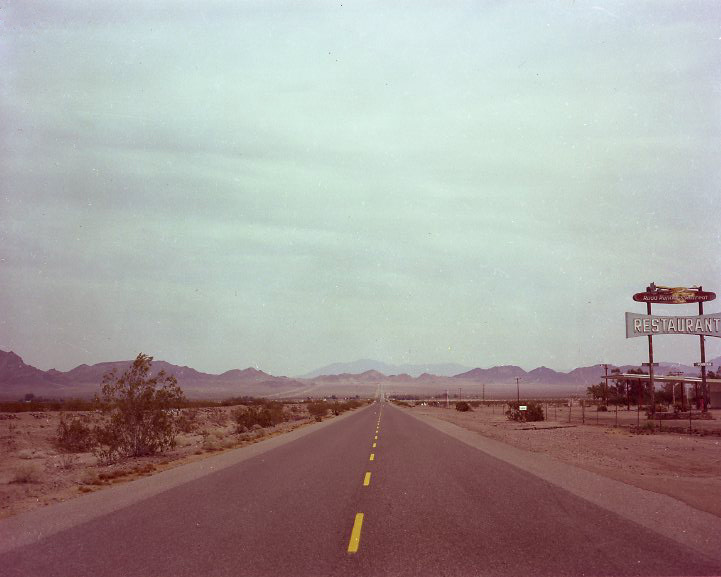
Mojave Desert along Route 66

Mojave Desert along Route 66

BrightSource Energy, Inc. cancelled its plans to build a solar farm on 600,000 acres of railroad land donated to the Department of the Interior for conservation. BrightSource builds, owns, and operates solar plants.

This is the land by Sen. Dianne Feinstein would like to see transformed into the Mother Road National Monument. If that happens, the land would connect the Mojave National Preserve to the north with the Joshua Tree National Park to the south, and the Colorado River to the east.

It is my long time interest in Route 66 that draws me to alternative energy and the Mojave, and how energy extraction changes landscapes.

For my first book on Route 66, Susan Croce Kelly and I took oral histories from poeple who built gas stations, motels, restaurants, and trading posts along the road after it was established in 1926 and before the passage of the Interstate Highway Act with funded the roads that replaced 66. The book Route 66: The Highway and its People is the basic text on the founding of the road and the creation of roadside tourism.

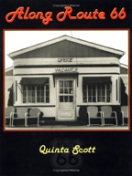
My second book, Along Route 66, is about the architecture of their buildings. Again, I drew on the oral histories Kelly and I had taken in the 1980s and on additional interviews taken by phone in the 1990s.

Now, I am interested in the landscapes the old road crossed from the Great Lakes to the Pacific, the coal fields and oil fields that lie under the landscape, and how we change the landscape when we extract energy from it.

This idea blossomed when I visited Moraine State Park, near Bloomington, Illinois, where Route 66 crossed the Bloomington Moraine, laid down by the retreating Wisconsinan glacier 15,000 years ago. The Twin Groves Wind Farm occupies soybean and corn fields just north of the park.

Twin Groves Wind Farm, Bloomington Moraine, LeRoy, Illinois

Twin Groves Wind Farm, Bloomington Moraine, LeRoy, Illinois

So if I seem preoccupied with things not Route 66, forgive me, but this is a new role the old road can play in my life and work.

Dry Wash, Mojave Desert

Dry Wash, Mojave Desert

Interior secretary Ken Salazar describes his agency as the “real department of energy.” He is in charge of the vast expanses of public lands in the western United States, lands that energy producers want to exploit for their natural resources, oil, coal, natural gas, and now wind and solar.

Which brings us to the Mojave Desert, sunny and windy, and much of it owned by U.S.

There is a five year backlog of applications for 158 solar projects on 1.8 million acres of public land, which could power 29 million homes. Half the projects would be built in the Mojave Desert, where some of the land is pristine, and some not.

The White House wants to streamline the application process and create 50,000 green jobs by 2011.

Roy's Motel, Amboy, California

Roy's Motel, Amboy, California

Pacific Gas and Electric is planning a solar farm near Roy’s Motel, a classic Route 66 business and a classic Route 66 story

Buster Burris was the wrecker king of Route 66 in the Mojave. He arrived in Amboy from Texas in 1938 and went to work for Roy Crowe at his gas and service station, driving Roy’s wrecker. Buster took over the business, and added a cafe in 1945 for feed people who waited for Roy to fix their cars. Three years later he added the little cabins to bed them down while they waited for Roy to fix their cars.

Roy's Motel, Amboy, California

Roy's Motel, Amboy, California

Roy’s grew into a small city out in the desert, even though drinking water was hauled in by the Sante Fe Railroad and stored on a siding.

Because the highway is there, because the railroad is there, because Roy’s is there, Pacific Gas and Electric claims the land is no longer pristine, and a solar farm near Roy’s will not damage the environment and be far enough away from Route 66 to not spoil the view from the road.

Sen. Dianne Feinstein and David Myers of the Wildlands Conservancy feel it is way to easy to use public land for energy production and that the planned solar projects will be way too big. Myers calls it the industrialization of the desert. Feinstein wants to establish the Mother Road National Monument on 800,000 acres of the land that would connect the Mojave National Preserve to the north with the Joshua Tree National Park to the south and the Colorado River to the east. And she wants to prevent the construction of solar farms on the land.

Lake, Moraine View State Park, east of Bloomington, Illinois

Lake, Moraine View State Park, east of Bloomington, Illinois

Two weeks ago I traveled up I-55, the road the replaced U.S. 66 though Illinois with plans to visit Moraine View State Park, just east of Bloomington, which sits on the highest elevation in Illinois.

When a glacier pushes south across a landscape it scrapes up soil, breaks down rocks into cobbles and gravel, and flattens the terrain. When it reaches its southern extent and the climate warms, it stops and drops the sand, clay, and rocks it has carried south and builds a morain, that rises above the flat landscape. As it withdraws, it stops and starts, stops and starts. With each stop it lays down a recessional moraine. In between the land is flat, wet, and marshy.

The Bloomington Moraine, about 20 miles east of Bloomington, Illinois, while not the southern extent of the Michigan lobe of the Wisconsinan ice sheet, tops out at 920 feet.

The park is lovely, its forest soothing, its lake pleasant, though artificial.

The big surprise is the wind farm that marks the northern edge of the park. Of course, high and windy, the Bloomington Moraine is ideal for a wind farm.

Twin Groves Wind Farm, Bloomington Moraine, Illinois

Twin Groves Wind Farm, Bloomington Moraine, Illinois

So, if you travel down Route 66 from Chicago or north from St. Louis, get yourself to LeRoy, Illinois and go north. Stop and have a picnic in the Moraine View State Park, and then continue north on McLean County Road 36.

And, should you not want to take the time to detour to the park and wind farm, there is a second one under construction up Route 66 near Odell in Livingston County.

Twin Grove Wind Farm, Bloomington Moraine, Illinois

Twin Grove Wind Farm, Bloomington Moraine, Illinois

Chain of Rocks Bridge, St. Louis

Chain of Rocks Bridge, St. Louis

Between August 29 and September 3 there will be a bike tour to promote the development of a Illinois Route 66 bike trail between Chicago and St. Louis. For those of you in St. Louis, it will start at the Chain of Rocks Bridge across the Mississippi, the old bridge that has been converted to a biking/hiking bridge. The ride will end at the beginning of Route 66 on Jackson Avenue near the Art Institute in Chicago. The Illinois Department of Natural Resources is developing the trail with the help of the League of Illinois Bicyclists.

The Bloomington Pantagraph has an extensive article on the section in McLean County, Illinois, which includes abandoned sections of the old route at Chenoa, Lexington, and Towanda.

For more information go to http://www.bikelib.org/route66/2009ride/ for information about food, lodging, and route. This last comes in a 14 page users’ guide.

For a great read-aloud guide to Route 66, check out my book Along Route 66 and my history of Route 66, Route 66: The highway and it people, with Susan Croce Kelly.

They are two Route 66 characters who, today, are better known for the artifacts they left on the roadside than for who they are.

Barn in Oklahoma

Meramec Caverns Barn in Oklahoma

Lester Dill owned and operated Meramec Caverns in Stanton, Missouri. And he promoted his cave with signs painted on barns all along Route 66 and throughout the Midwest. He painted his first barn on the Ohio Turnpike in the thirties: See Meramec  Caverns, U.S. 66, MO.

Meramec Caverns Sign, Missouri

Meramec Caverns Sign, Missouri

Travelers saw the first barn, then the second barn. With each sighting the anticipation became intense. Children clamoured to see the cave. Parents caved when they got to Stanton. And, in the days before air conditioned cars, it was a steady 58 degrees in the cave, a place to cool off from the summer heat.

Read the full story about Lester and his cave and his barns in Route 66: The Highway and its People, Photographs by Quinta Scott, Text by Susan Croce Kelly. Its available at the Along Route 66 Bookstore.

Lester Dill had a public face, a familiar character on late night television.

Cadillac Ranch, Amarillo, Texas

Cadillac Ranch, Amarillo, Texas

Stanley Marsh is not. No barns announce the Cadillac Ranch, a sculpture just west of Amarillo, more on I-40 than U.S. 66. There is no anticipation. If you don’t look north from I-40, you just might miss it. But travelers somehow get to the side road, clamour over the fence, and risk picking up chiggers in the grassy field where ten Cadillacs are planted nose down in the soil.

Cadillac Ranch Amarillo, Texas

Cadillac Ranch Amarillo, Texas

The ranch is a work in progress. Graffiti artists change it weekly. Every photograph of it is different. When I made photographs of it, it was not nearly as colorful as it is today.

Grant Park, at Jackson and Lake Shore Drive, Chicago

Grant Park, at Jackson and Lake Shore Drive, Chicago

When Chicago, founded in 1833, incorporated Fort Dearborn into its townsite six year later, it designated the land east of Michigan Avenue public land. In 1844 the city name the old fort, Lake Park. Eight years later the city built a causeway just off shore, creating a lagoon between the beach and the roadway, which turned in to stagnant water. The city filled the lagoon with debris from the Chicago fire in 1871 and in 1896 extended the park into the lake with landfill. It became Grant Park in 1901.

Next Page »